New content management system – new opportunities

Many companies still create technical documentation with traditional word processing software. What may seem practical for small projects quickly reaches its limits as the scope and requirements increase. Different document versions are in circulation at the same time, content is created multiple times and quality suffers due to a lack of consistency. The solution to these problems: The introduction of a content management system. But what does that mean in concrete terms? What opportunities do these offer, what needs attention and how can DOGREL help you install and maintain such a system?    

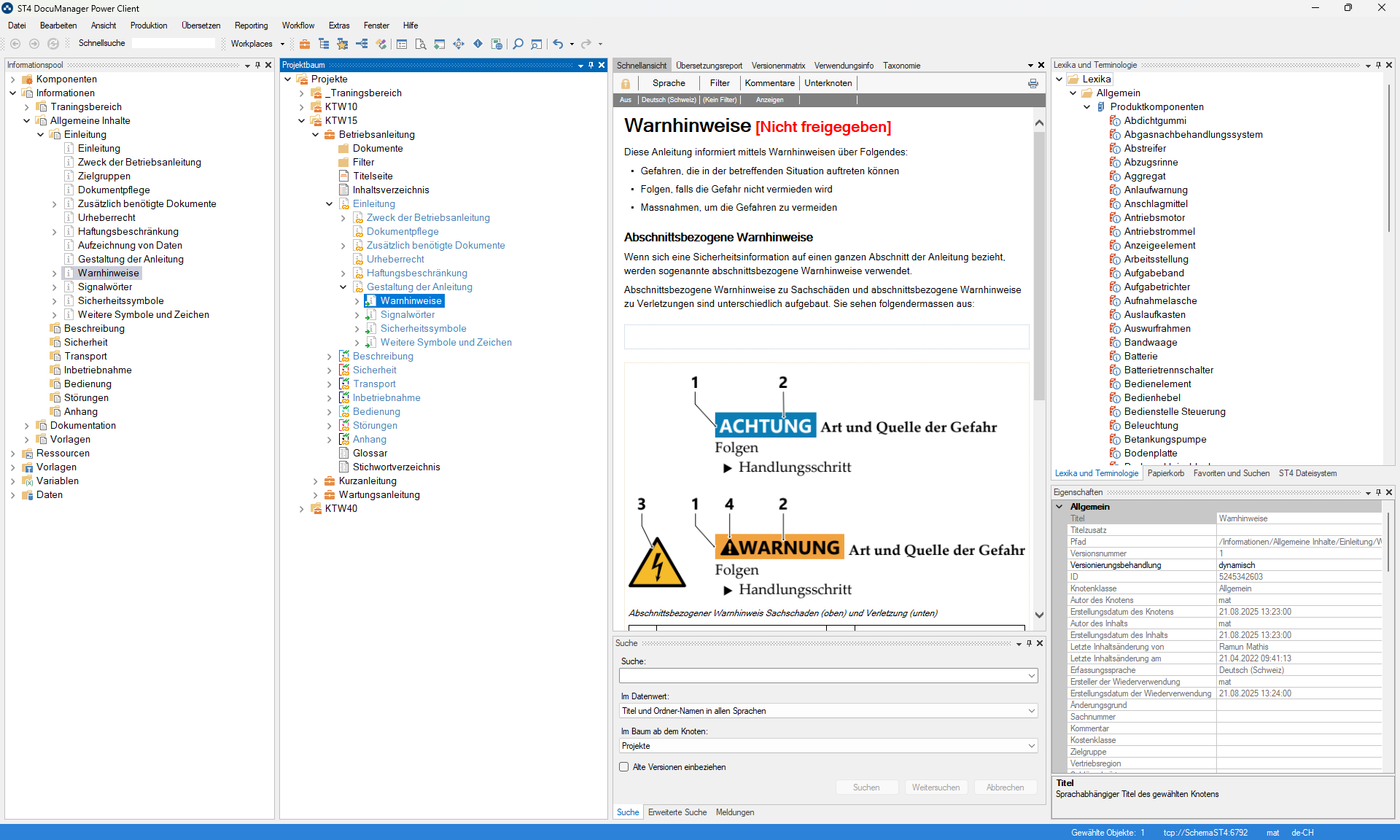
A content management system is far more than just an ordinary word processing programme with a few added functions. It is a specialised software solution that is customised to suit technical documentation requirements. The decisive difference is its modular design, as content is no longer handled as rigid, self-contained documents, but is broken down into smaller information modules. These can be entire sub-chapters or shorter sections such as safety instructions or brief texts. The modules can be created and maintained centrally and reused in as many documents as required.

Furthermore, a content management system assists the documentation process with a range of extra functions. These include version and translation management, which help maintain an overview of the current module status, automated workflows minimise the work necessary to export translations or generate documents and single-source publishing makes it easy to publish content in different file formats. Author support and terminology search functions also guarantee more consistency when writing content.
 

The advantages of a content management system are therefore plain to see. It means cost and time savings when creating, translating and publishing content while ensuring higher quality and greater consistency. More legal certainty is also provided. A content management system makes compliance with standards and guidelines easier, as they specify clearly defined processes and professional working methods for technical documentation.

What needs attention before installation and use?
As impressive as the advantages are, the introduction of a content management system is not automatically a sure-fire success. It means organisational and technical changes that need careful planning and monitoring. Thorough preparation is therefore crucial before its launch. Success depends not only on the choice of CMS, but also on clarity regarding processes, target groups and media.

A process analysis helps define how a future workflow for CMS work could be. From where and in which form does the information for the technical documentation come and how can this information be effectively integrated into the CMS efficiently and without errors?

On the other hand, a target group analysis serves to determine the form in which the content should reach the end user. This affects the degree of detail in the documentation and possible splitting of the information into different document types. The target groups also have an impact on the choice of media for the documentation. Will it be made available to the end user in printed form or maybe in digital form for downloading online? With the new Machinery Regulation manufacturers will have more flexibility in this respect in the future.

Concept
When preparation work has been completed, a clear concept for the introduction of the CMS can be developed. This concept serves as the central theme for all further steps and defines how the technical documentation will be organised and made accessible to users in the future.


An investment in the future
The introduction of a content management system is more than just a software decision. It is a strategic investment in the efficiency, quality and future viability of your technical documentation. At the same time this step requires careful planning, clearly defined goals and good ideas for successful processes and results. This is where it pays to have an experienced partner at your side.
DOGREL accompanies you from the initial analysis and provides ongoing support to ensure that the launch of the system does not become a burden but an opportunity for your company.
 

Ramun Mathis
Team Leader, Documentation

The choice of CMS is the obvious first step that has a decisive effect on the other aspects of the concept. Not every system is suitable for all concepts. The system must meet all the requirements that were defined prior to the system launch, but must also be suitable for future users. These users should ideally work in a team with several members who should be familiar with all tasks and processes of the CMS. As a result, successful launch and use of the CMS is not dependent on an individual person.

The concept must not only focus on the creation of content, but also on its output. The media mix that best meets the previously defined requirements must be specified. The content can be made available as different document types, for example, (e.g. quick guide, operating instructions and maintenance instructions), which are then also made available in different forms (e.g. the quick guide as a printed manual and the operating instructions and maintenance instructions as digital HTML documentation).
 

Successful launch

Switch from Word & co. to a professional content management system – modular, efficient and future-proof. 
We help you choose and implement the right system and provide ongoing support.

Book an online consultation with no commitment whatsoever: www.dogrel.com/kontakt