

Akte mit der Beschriftung Risikobewertung
To ensure that the product is safe, it is of the utmost importance that the relevant safety information finds its way to the user. But in reverse, findings from working with the operating instructions can also help to improve a risk assessment. In this regard, the technical editing department is the link between development and safe usage of the product.
The risk assessment plays a central role in the development of a safe product. This is why so many people take part in drawing up the risk assessment. And, in theory, technical authors should also be involved. However, this is often not the case in practice. Instead, when they start their work, they often find that the document they hold in their hands was created without their involvement. They only get to see the final written text – but potentially essential background knowledge remains unknown to them. This makes it all the more important that they know how they are supposed to work with the risk assessment and how the information from the internal documentation (risk assessment) needs to be transferred to the external documentation (operating instructions).

Risk assessment and technical authors
The risk assessment represents many things to a technical author. One thing it is definitely not is just a simple listing of warning instructions that can be merely copied and pasted straight into the operating instructions. It takes much more to properly embed the risk assessment. This requires good instincts and a great deal of experience. For example, the different types of content contained in the risk assessment are reflected in different ways in the operating instructions or as other information documents for users:
Warnings laid out in accordance with the SAFE method are probably the most striking safety-related information in the operating instructions. It is extremely important here that every letter in the acronym is taken into account. The correct Signal word (S) must be chosen, the Action or type of danger (A) and Failure or consequence (F) must be clearly described and the Essential action to escape the danger (E) must be stated as an unambiguous instruction. The information required for implementation of a SAFE instruction should be clearly evident from the risk assessment. Unfortunately, however, this is not always the case. For example, the only point of reference often provided is the type of danger involved. It is then up to the author to collect the remaining information, hopefully with the aid of the product developers. The outcome of this research can then not only be used in the operating instructions, but also serve as feedback for the risk assessment.

We would be delighted to help you prepare safe and reliable operating instructions
✓ Complete overview of all aspects of a risk assessment, including target groups, limits, lifecycle phases ...
✓ Safety incorporation: SAFE method, warnings...
✓ Ensuring product safety with the aid of warning signs and safety devices
Ramun Mathis
Team Leader, Documentation

Abb.: Warnhinweis nach der SAFE-Methode – das Layout ist nicht strikt vorgeschrieben; es sollte so gewählt werden, dass der Lesefluss nicht zu stark unterbrochen wird
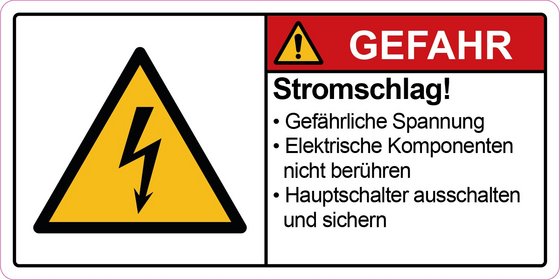
Abb.: Warnschild – Aufbau nach ANSI-Vorgaben führt zu wirkungsvoller Warnung
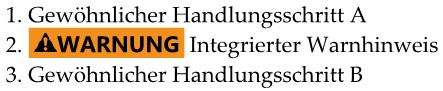
Abb.: Warnhinweis nach der SAFE-Methode – das Layout ist nicht strikt vorgeschrieben; es sollte so gewählt werden, dass der Lesefluss nicht zu stark unterbrochen wird
As a general rule, warnings in the operating instructions should only be used wherever the danger is relevant. The use of too many warnings (e.g. in the form of a listing of warnings) is generally not advisable. It is also possible to warn the user about residual risks directly within the description of a procedure. In this case a slimmed-down warning (embedded safety message) should be used.
Fig.: Embedded safety message – The warning is placed in a relevant location and the reading flow is not interrupted.
Warning signs must be used in cases where there is a direct danger on the product. These can warn the user directly and reliably about risks that are present. Here again, the requirement for warning signs should be evident from the risk assessment. However, technical authors can also bring their own experience into play here and offer feedback if too many or not enough warning signs are required. In addition, information should also be provided in the operating instructions. The placement and appearance of the warning signs should be set out so that the user can perform regular inspections and replace warning signs if necessary.
Fig.: Warning sign – The layout in accordance with the ANSI requirements ensures clear, consistent and effective communication of warnings.
Of course, the information in the risk assessment is not only relevant for the operating instructions. The 3-stage safety concept (inherently safe design → definition of the necessary technical and supplementary protective measures and safeguards → information/instruction for the user) defines clearly that dangers should first be prevented by the design of a product and its safety devices. However, this information from the risk assessment is also relevant for technical authors and impacts on the operating instructions. A description of technical protective measures and safeguards on the product must be provided for the user. For example, the user should e.g. be informed about safety signals (signal tones, flashing lights) so that indications and feedback from the product remain predictable and clearly understood. In addition, the safety devices (e.g. emergency stop buttons) must be described so that inspections can be carried out.